
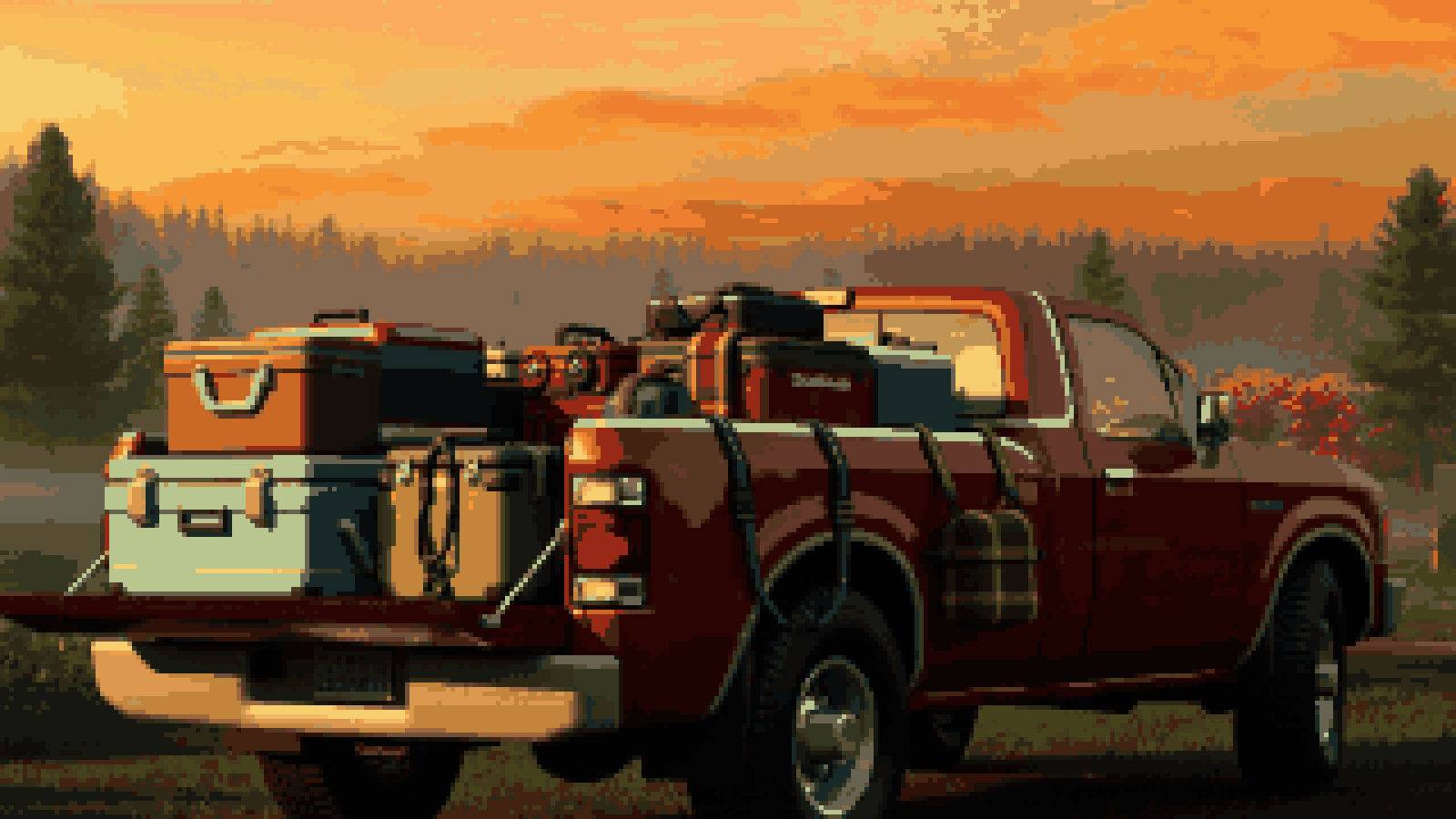
To pack a truck for a hunting or fishing trip, load the gear you need last first, put heavy items low and toward the cab, group everything into labeled totes, and keep the things you need on arrival within reach. Then tie the load down with ratchet straps, not bungee cords, and check it again after the first few miles.
Safety note: This is general information, not professional advice. Your truck's owner's manual and your state's rules come first.
What order should you load a truck in?
Think in reverse. The last thing you load is the first thing you will want when you arrive, so build the load backward from your trip.
- Bulk and base camp gear first. Tents, cots, stoves, big coolers of food for later days and anything you will not touch until camp is set up.
- Heavy totes next. Fuel cans, tool boxes, ammo cans and anything dense go low and toward the cab, so the weight sits over the axles instead of hanging off the tailgate. U-Haul's pickup guide gives the same advice: heavier cargo toward the front, lighter near the tailgate, and heavier items at the bottom of any stack.
- Medium totes and soft bags on top. Clothing, sleeping bags and food totes fill the gaps.
- Arrival gear last. Rain jackets, boots, headlamps, the day cooler, licenses and a first aid kit go on top or in the cab.
A good test: if you had to pull over at a gas station in the rain, could you reach your jacket without unloading anything? If not, move it.
How should you use totes?
Totes turn a pile of gear into a few rectangles that stack. They are the whole idea behind our game Pack Out, and they work in real life for the same reason.
- Pack by job, not by item. One tote for the stove and cooking kit, one for fishing tackle, one for hunting clothes, one for first aid and tools. When you need something, you know which box to open.
- Label the lid and the end, since the end is what you see in a stack.
- Match sizes. Totes of the same footprint stack flat and do not shift.
- Keep totes light enough to lift. If a tote is too heavy to carry alone, split it. A heavy tote on the top of a stack is also a hazard.
- Put sharp or wet items in their own tote. Knives, hooks and wet waders should not share space with dry clothes.
What should go in the cab instead of the bed?
Anything that is fragile, valuable, or needed on the road. That usually means:
- Phone chargers, maps and a flashlight.
- Medications and a small first aid kit.
- Licenses, tags and permits.
- Snacks and water for the drive.
- Optics, electronics and anything that must stay dry.
Firearms need extra care. Transport rules differ by state and by trip, so check your state's wildlife agency before you go and follow its rules for cases and unloading.
How heavy is too heavy?
Know your limit. Federal rules require most light vehicles to carry a Tire and Loading Information placard, and it lists the total load capacity of the vehicle for occupants and cargo, as described in 49 CFR 571.110. On most trucks, the placard is on the driver's door edge or door post. Your owner's manual explains it.
Remember that people count. Add up the passengers, the cooler full of ice, the water, the fuel and the gear. A truck loaded past its capacity handles and brakes worse, which matters most with a trailer or a loaded bed on a long grade.
How do you tie down a load?
Loose cargo is a road hazard, and it is also against the law in many places. In Minnesota, the statute says a vehicle must not be driven unless it is loaded or covered to prevent any of its load from dropping, sifting, leaking, blowing or otherwise escaping. Check your own state's rule, since details vary.
The National Highway Traffic Safety Administration tells drivers it is their responsibility to secure what they carry, and says to tie cargo down with rope, netting or straps. It also advises tying large objects directly to the vehicle or trailer, covering the load with a sturdy tarp or netting when needed, and not overloading.
A few practical rules:
- Use ratchet or cam straps. The Minnesota State Patrol told CBS News it sees bungee cords, twine and rope used on loads, and recommends ratchet or toe straps instead.
- Use anchor points. Run each strap through a bed anchor, over the load and back, and tighten until nothing moves.
- Check the strap rating. Straps carry a working load limit. For scale, the federal rule for commercial vehicles in 49 CFR 393.106 says the combined working load limit of tie-downs must be at least one-half the weight of the cargo. That is a commercial rule, not a pickup requirement, but it is a sensible floor to aim for.
- Cover the load. A tarp or cargo net keeps light items from blowing out and keeps the load dry.
- Stop and check. The State Patrol also advises stopping periodically to confirm the load is still secure. Do it after the first few miles, when straps settle, and again at fuel stops.
Watch load length, too. Minnesota limits a load to three feet past the front bumper, and other states set their own limits for rear overhang and flags.
What do you do with a cooler, rods and long gear?
Coolers go where they will not slide: against the bulkhead or wedged between totes, with a strap through the handles if needed. Keep a small day cooler in reach and the big one deeper in the load.
Rods and long gear ride best in a rack or tube, tied at two points, with sharp tips padded. Check your state's rules before letting anything stick out past the tailgate.
Can you practice packing a truck?
You can, and it is surprisingly fun. In Pack Out, you tap gear off a messy pile into matching totes before your tailgate runs out of room. Plan your grabs around which tote is coming next, because one careless pick can jam the entire load. Clear the pile and your truck rolls out across a illustrated map of the USA, stopping at real hunting and fishing spots, starting with the lakes of Minnesota.
Pack Out is out now, free on the App Store: download Pack Out. See it on the homepage, and read a mobile game that starts in Minnesota for where the first stops are. The whole lineup is in our 4 mobile games. Sign up for launch alerts to hear about updates and the next game. If you want to know what kind of puzzle it is, read what is a sort puzzle game.
FAQ
What goes in the truck first when packing for a trip?
Bulk and base camp gear, such as tents, cots and large coolers, goes in first. Heavy totes go next, low and toward the cab. Gear you need on arrival goes in last.
Should heavy items go at the front or the back of the bed?
Toward the front, near the cab, and low. U-Haul advises placing heavier cargo toward the front and lighter cargo toward the tailgate, with heavy items at the bottom of any stack.
Are bungee cords good enough to tie down a load?
No. The Minnesota State Patrol says it sees bungee cords, twine and rope used on loads, and recommends ratchet or toe straps instead.
How do you know how much weight your truck can carry?
Check the Tire and Loading Information placard, usually on the driver's door edge or door post, and your owner's manual. Count passengers, ice, water, fuel and gear together.
How many tote bins do you need for a hunting trip?
There is no set number. Pack by job, such as cooking, tackle, clothing and first aid, and keep each tote light enough to lift by yourself.
